| VASTU
AND HOSPITAL COMPLEXES |
|
| Over the
last few years, we have seen the gradual rise and awareness in the subject of
Vastu not only in India but also in other parts of the globe. Let us see how
the great science of Vastu helps in alleviating people's sufferings by adapting
the principles of Vastu to the construction of a hospital complex. |
|
| Surgery
in Ancient India |
|
| In
ancient India, medicine had acquired the highest degree of proficiency. Indian
medicine (Ayurveda) dealt with the subject in totality, as a whole. It
described the structure of the body, its organs, its ligaments, muscles,
vessels and tissues. Their materia medica contained resourceful processes of
preparation with detailed instructions for the management and categorization of
medicines. A great deal of attention was devoted to cleanliness and sanitation,
diet and regimen of the body. |
|
| The
main distinction of modern allopathic medicine is surgery. Ancient Hindus
excelled in surgery too. The ancient medical men beginning from the great
Dhanawantri (whose prescriptions were said to be infallible). Sushruta,
Charaka and others down the line were bold and skilful in their surgery. They
conducted amputations, arrested bleedings by pressure, bandage or boiling oil,
performed operations in the abdomen and uterus, curved harnia, fistula and
piles, set broken bones and dislocations and could deftly remove foreign
substances from the body. The great surgeon Sushruta is said to have advised
dissection of dead bodies to a student of surgery and stressed the importance
of knowledge gained from experiment and observation. |
|
| The
ancient medical men of India were the first to establish hospitals and for the
centuries, they were the only ones to maintain them. Speaking about a hospital
in Pataliputra (of King Chandragupta II), a Chinese traveler Fa Hein tells us
that all poor and helpless patients that came there were taken excellent care
of. Food and medicine were provided according to their needs and a doctor was
in constant attendance. |
|
| Modern
Hospital
|
|
| Coming
down to the modern age, why is a hospital needed? A hospital is needed to
provide health care to the people, both preventive and curative. As it provides
a very essential service, the hospital and its staff have to efficiently and
consciously work to prevent disease, restore health and alleviate the malady. |
|
The
hospital is a organization that has to function as a group of teams. The teams
can be broadly classified as :
1). Patient care team consisting of doctors, nurses, pharmacists, medico-social
workers and dieticians,
2). Investigative team consisting of lab technicians, radiology technicians,
nurses, pathologists, micro-biologists,
bio-chemists and radiologists and
3). Supportive team consisting of maintenance and house-keeping staff,
transport staff, aides and helpers.
|
|
| Basically,
each hospital has two departments --- one for outpatients and the other, for
inpatients. The outpatient department is defined as a regular part of the
hospital with scheduled part of working with medical and other staff to provide
care for patients who are not registered as inpatients. |
|
| The
outpatients services can be preventive. Promotive, curative, follow-up and
rehabilitative. The OPD also includes family welfare services, health, medical,
para-medical and nursing services. |
|
| The
inpatient department is defined as another part of the hospital, which allows
the patients to stay in the hospital, which allows the patients to stay in the
hospital for days together with medical and other staff providing total care
for the patients. |
|
| The
operation theatres, major and minor, are important segments of a hospital.
These have to be segregated from other departments. It is necessary to
understand the concept of protective, dirt-free, aseptic and disposal zones. |
|
| Other
blocks consist of premature units (neo-natals and nursing new-borns) and
pharmacy (for medicine providing). Apart from these, a hospital needs to have
laboratories, which consist of clinical pathology, micro-biology,
bio-chemistry, hematology and histo-pathology sections. Here, provision for
waiting rooms and toilets have to be made. They also need radiology (X-ray
rooms etc.) departments. Of course, due provision for a central Sterile Supply
Department (CSSD), casualty, power stations (generator rooms),
kitchen/canteen,stores, laundry, workshops, garages, mortuary, residential
campus and community center can be made. |
|
| Application
of Vastu
|
|
| The
planning begins with locating a proper site. The basic considerations, of
course, will be to select the site near main roads. This way, the accessibility
to the hospital will be good. North-east sites are ideal for hospitals. But if
corner sites are not available East and North-facing sites are recommended.
Many a time, there are also not available and you may be forced to go in for a
West or South facing site. A West-facing site may be preferred to South-facing
one. Do not despair if you get a South-facing site. Vastu can be applied
judiciously to get the sites the needed balance. Proper orientation to the
cardinal directions is definitely recommended. A site that has all sites equal,
would be ideal. In a square, all the primary elements of nature --- udaka
(water), gagana (space), pavana(air), dahana(agni) and prithvi (earth) are well
balanced. If a rectangular site is selected, a length not more than twice the
breadth may be chosen. |
|
| Once
the site is selected, the planning of the structure begins. Allow a minimum of
one-ninth of the site free on all four sites. This can be used for movement of
traffic, trolleys and stretchers. This one-ninth relates to the Paisacha or
non-habitable zone of the site. |
|
| Let
us begin the assumption that the hospital has ground plus three floors with a
basement. |
|
Manasara
has spoken of different heights for different breadths. Different heights
called variously as Santika (height=width), Paushtika (height = 1 1/4 times the
width), Jayada (height = 1 1/2 times the width), Sarvakamika or Dhanada (height
= 1 3/4 times the breadth) and Adbhuta (height = twice the breadth) are
described. Different breadth measurements in terms of Hasta (cubits) are given
based on which we can design a building.
The basement can be for car and other vehicle parking. |
|
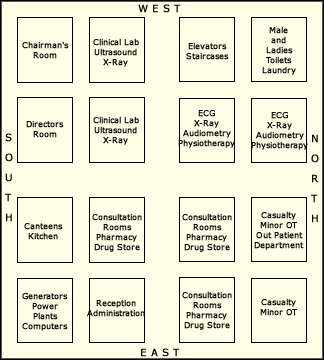
| The
ground floor (Fig. 1) can consist of the chairman's room, pharmacy, reception,
the casualty (or emergency) department and the minor operation theatre, the
ECG, audiometry, X-ray and physiotherapy rooms, the consultation rooms, the
laundry, the kitchen/canteen, the clinical lab, the ultrasound room, the
generator and plant room, the laundry, toilets and, of course, the staircase
and elevators (lifts). |
|
 |
| Figure
1
|
The chairman's and other director's offices, the clinical lab and ultrasound
can be in the nairutya (South - west), dakshina (South) and Pashchima (West)
sectors. Canteens, kitchens, generator and plant rooms can be in the agneya
(South - east) sector. The elevators/staircases, laundry and toilets can
be in the vayuvya (North - west) sector of the structure. The central from the
North to South and East to West corresponding to 1/9th of the length (or width)
can be kept open for fast and free movement of stretchers, wheel chairs,
trolleys, doctors and patients. |
|
| As the
casualty and the minor operation theatres are immediate necessities, these can
be in the easanya (North - east) of the building for entry into them with ease. |
|
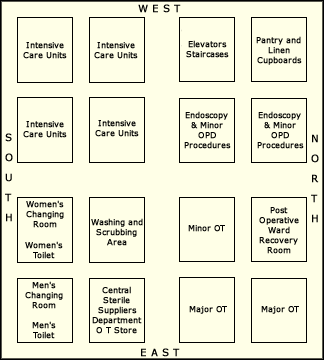
| Coming into the
first floor (Fig. 2), the hospital can house the operation theatres (both major
and minor), the intensive care unit, the post - operative ward and recovery
room, the central Sterile Supplies Department (CSSD), the operation theatre
store, changing rooms/toilets for men and women, washing/scrubbing area, the
endoscopy and the minor OPD procedures. |
|
| The intensive
care units can be in the South - west and the South sectors, the CSSD and the
changing rooms can be in the East and South - sectors. The major/minor
operation theatres and the post - operative and recovery rooms can be in the
North and North-east sectors, the endoscopy room and the minor OPD procedures,
the men/women changing rooms and toilets can be in the West, North and
North-west sectors. The scrubbing and washing areas, the pantry and linen
cupboards and the CSSD can be in the South and South - east sectors. |
|
 |
| Figure
2 |
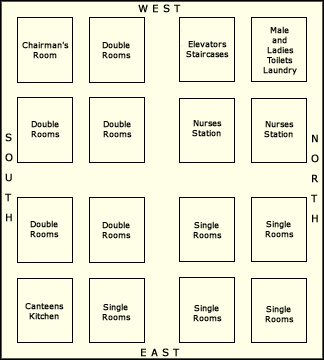
In the second floor (Fig. 3), the hospital can house the patient's single and
double wards and the nurse's dormitories. The chairman's room and the
double wards can be in the South, West and South - west sectors, the
single wards can be in the North - east, the nurses' dormitories in the North,
canteens and kitchens in the South-east, and toilets and laundry in the North -
west sector. |
|
 |
| Figure
3 |
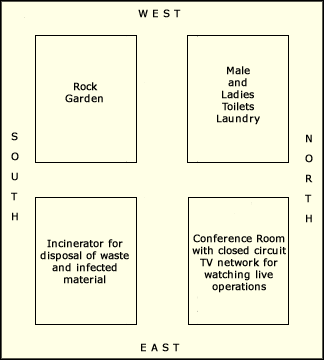
The third floor can have the conference rooms having close circuit TV network
for watching live operations in the North, East and North - east sectors and
the incinerators used for disposing of waste and infected material can be in
the South - west sector. The male and the female toilets can be in the North -
west sector and the South - west and the South sectors can be strengthened with
a rock garden such that it slopes to the North/East. |
|
 |
| Figure
4 |
Importance of Sleeping Positions |
|
| The
patients cots can be placed such that their heads are to the South. This way,
the magnetic energies coming from the various sides and the polarity induced in
the body vibe with each other to maintain a balanced blood circulation in the
body, thereby strengthening the healing and curative properties of the body. |
|
| Our
ancients have found out scientifically that sleeping with the heads towards the
South will enable one to go with nature and draw the maximum positive energies
from the cosmos to keep one fit and healthy. That they were past masters in
known and unknown physical and other sciences is clearly understood by the fact
that the sleeping direction is correlated with the physical science of
magnetism and electricity. The great sage Garga is said have said that one
should lie with his head placed southward if he wanted to live long. Sage
Markandeya says that one is strong and lives long by placing one's head to the
South. |
|
| When
the eastern part of the earth is heated, its western part remains cold.
Consequently, the thermal electricity generated by the sun travels over the
surface of the earth from East to West. The earth thereby becomes magnetized
and its geographical North Pole, which is to the right hand side of the
direction of the current, becomes the magnetic North Pole and its geographical
South Pole being on the left - hand side of the same current becomes the
magnetic South Pole. |
|
| The
earth is a magnet and this is evident by placing a compass needle that
invariably points to the North and South Poles. It has also been proved by
experiments that the human body is a magnetiseable object and that it
contains a large percentage of iron in the blood that circulates all through
the body. As our feet are always in touch with the Northern Hemisphere of the
earth, which exhibits the properties of north polarity, south polarity is
induced in out feet and consequently north polarity is induced in the head.
|
|
| The
body will have stable health if the head is placed to the south, thereby
preserving the natural polarity of the body. On the otherhand, when the head is
placed to the north, there is repulsion between the two like poles of the body
and the earth, blood circulation is affected and disease sets in. |
|
| Our
ancients who were men of great scientific and spiritual wisdom, have handled
over treasures down the period. As intelligent people, we just need to make use
of these gems and pearls that have come down to us on a platter and use it with
grace and dignity for betterment of mankind at large. |
|
|
|